
What makes real Vietnamese pickled bamboo shoots
A jar of good pickled bamboo shoots doesn’t rely on a long ingredient list. It comes down to one decision made before any pickling starts: which bamboo you cut. We work almost entirely with tre gai (spiny bamboo), a variety known for a naturally crisp bite and a clean, light sweetness that holds up through fermentation. Cheaper varieties go soft and bland in brine. Tre gai doesn’t.
- Bamboo species: tre gai (spiny bamboo)
- Selling point: natural crunch and mild sweetness retained after fermentation
- Common substitute varieties: often softer texture, weaker flavor once pickled
How Vietnamese pickled bamboo shoots are made
There’s no shortcut version of this process, and we don’t pretend there is. Shoots are cleaned right after harvest, before anything has a chance to dry out or turn bitter. The tough outer sections get trimmed away, and what’s left is sliced into thin, bite-sized pieces. From there, it’s brine, wait, drain, and brine again — a slow natural fermentation, not a quick soak in vinegar. Nothing here is instant, and that’s deliberate.
- Step 1: Clean shoots immediately post-harvest
- Step 2: Trim away tough, aged sections
- Step 3: Slice thin, to a consistent bite size
- Step 4: Submerge in a light salt brine
- Step 5: Change the brine and continue fermenting until the sour taste settles in naturally
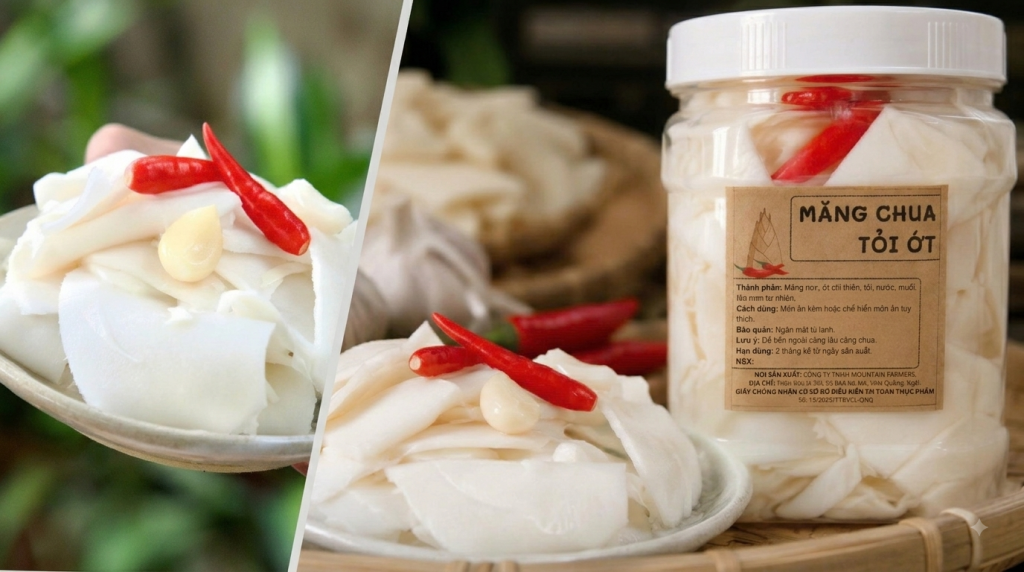
The taste of Vietnamese pickled bamboo shoots, without extra additives
Here’s an honest comparison. Machine drying and quick vinegar brines are fast, consistent, and easy to scale — there’s nothing wrong with that approach for many products. What slow salt fermentation gives up in speed, it makes up in flavor complexity: a gentler sourness, a crunch that doesn’t go mushy, and a smell that’s closer to fresh bamboo than to straight vinegar. It also depends on weather and patience, which is exactly why a rushed batch tastes flat. We’d rather wait than skip a stage.
How to enjoy Vietnamese pickled bamboo shoots at home
This isn’t a garnish you sprinkle on for looks — it’s meant to be eaten in quantity, right alongside the main dish. A few ways we actually use it:
- Stirred into a simmering pot of sour fish or pork rib soup (canh chua)
- Tossed with fresh herbs, chili, and a splash of fish sauce as a quick side salad
- Paired with grilled or braised pork belly, where the sourness cuts through the fat
- Eaten straight from the jar with steamed rice on a plain weeknight
Nutrition notes on Vietnamese pickled bamboo shoots
Bamboo shoots on their own are low in calories and carry a meaningful amount of dietary fiber, plus potassium, copper, and B-vitamins. That fiber content is part of why bamboo shoots have been studied for supporting regular digestion, and some research points to a possible prebiotic effect that feeds beneficial gut bacteria. Fermentation adds another layer worth mentioning, since fermented vegetables in general are a source of naturally occurring live cultures.
Bringing a jar home
A jar of pickled bamboo shoots travels well, keeps in the fridge for weeks once opened, and gives you a real taste of a Vietnamese home kitchen instead of a souvenir shelf. If you’re picking one local specialty to pack in your suitcase, this is one that actually gets eaten, not just looked at. Tell us in the comments if you’ve tried canh chua with it — we’re always curious how people outside Vietnam end up using it first.
Reference Source: Healthline
#AnNong #VietnameseTraditional #PickledBambooShoots #MangChua